Paperless Transformation on AWS: Building a Cloud-Native, Event-Driven Intelligent Document Processing (IDP) Platform
By Satish Gupta • 5/28/2026
Introduction
The IDP (Intelligent Document Processing) and IPA (Intelligent Process Automation) space is changing rapidly with the evolution of cloud computing. Every organisation is looking to modernise its IDP technology stack. The design is shifting from monolithic, tightly coupled solutions to event-driven and microservices-based architectures.
In this article, I will explain how to modernise a traditional IDP technology stack using cloud-native AWS services.
What Does an IDP Platform Do?
An IDP technology stack mainly involves ingesting documents through scanning, email, or post, extracting information from the documents, storing metadata, saving documents into a content management solution, and triggering workflows for business teams when business processing is required.
Traditional Enterprise IDP Architecture
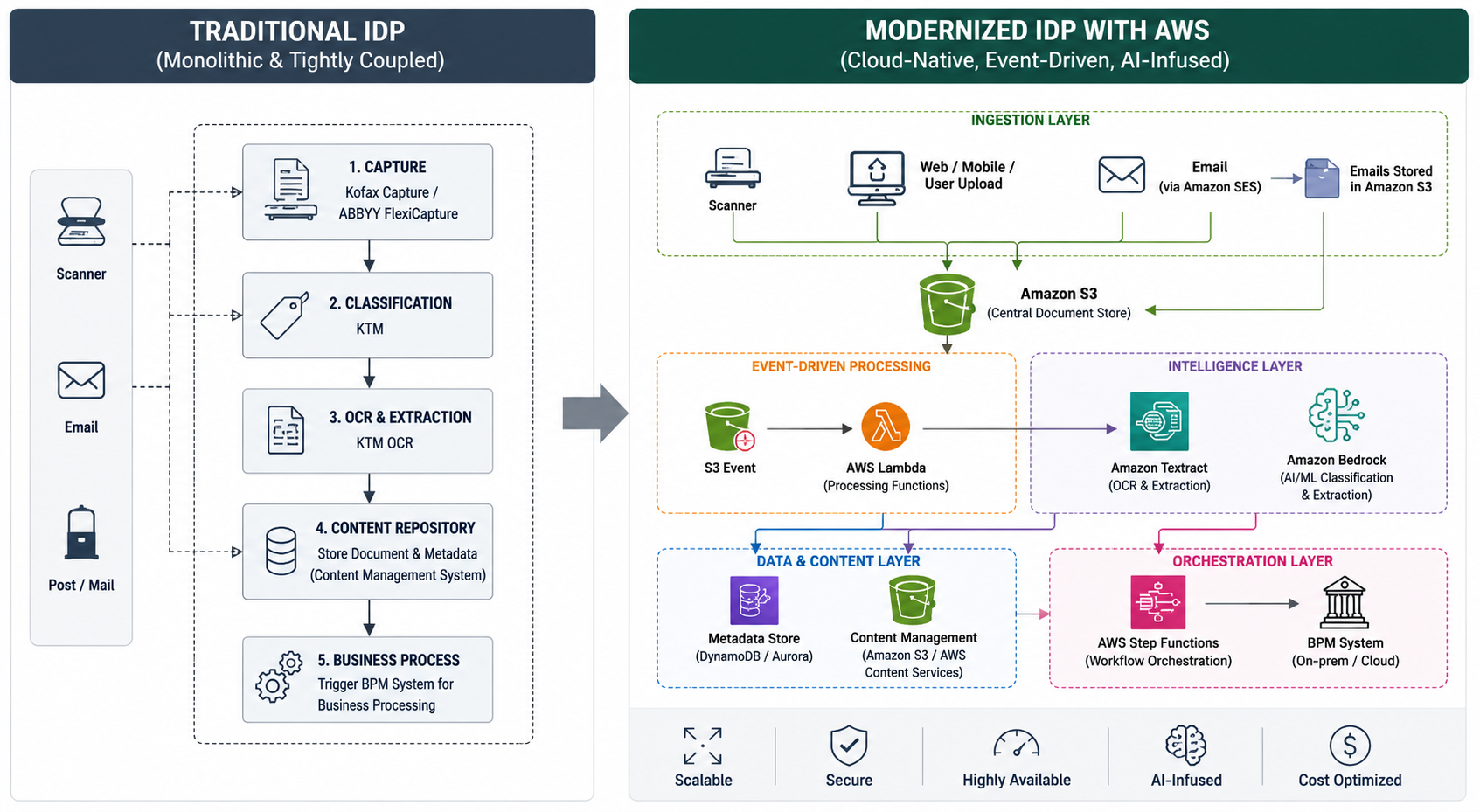
Traditionally, document scanning was handled using tools such as Kofax Capture or ABBYY FlexiCapture. Documents received through email or scanning would be processed by KTM for document classification and OCR. The extracted data and documents would then be stored in a content management solution. If business process orchestration was required, the system would integrate with a BPM platform.
While these solutions have served organisations well for many years, they are often tightly coupled, expensive to scale, and can be difficult to extend with modern AI capabilities.
Moving to a Cloud-Native Architecture
So, how does this look in a cloud-native world?
Documents scanned by scanners can be uploaded directly into Amazon S3 using an upload service. The same upload service can also be used for documents uploaded by users through web or mobile applications.
Email ingestion can be handled using Amazon SES. Incoming emails can be received through SES and stored directly in Amazon S3.
At this stage, Amazon S3 becomes the central entry point for all document ingestion channels.
Event-Driven Processing with AWS
Once documents land in S3, S3 events can trigger AWS Lambda functions.
This event-driven model decouples services and allows each processing stage to scale independently. Instead of relying on a single monolithic platform, each component performs a specific responsibility and communicates through events.
This architecture improves scalability, resilience, and operational flexibility.
Intelligent Classification and Extraction
Document classification can be implemented using business rules within AWS Lambda functions or through AI and machine learning services.
AWS Bedrock introduces a powerful approach to document understanding by enabling organisations to leverage foundation models without managing GPU infrastructure or model hosting. AWS manages scaling, inference, security, and API access, allowing teams to focus on business outcomes.
For OCR and document extraction, services such as Amazon Textract can be integrated into the processing pipeline.
AI integration is one area where cloud-native architectures truly outperform traditional platforms. I will write a separate article covering AWS Bedrock in more detail.
Metadata and Content Management
Once classification and extraction are completed, the metadata and documents can be stored in a content management solution.
Depending on the organisation's requirements, metadata can also be stored in databases such as DynamoDB, Aurora, or other enterprise repositories.
Business Process Orchestration
Further events can then be used to trigger BPM systems whenever business process orchestration is required.
Modern orchestration services such as AWS Step Functions or existing enterprise BPM platforms can be integrated to support business workflows, approvals, and exception handling.
Benefits of a Cloud-Native IDP Platform
A cloud-native IDP architecture offers several advantages:
Elastic scalability
Reduced infrastructure management
Faster AI adoption
Improved resilience and fault tolerance
Event-driven processing
Lower operational overhead
Faster delivery of new capabilities
Conclusion
The future of IDP is not simply OCR running in the cloud. It is an intelligent, event-driven platform where AI services continuously classify, extract, validate, and route information with minimal operational overhead.
AWS provides the building blocks to modernise traditional document processing platforms while enabling organisations to become more scalable, secure, and AI-enabled.
Have you implemented an IDP platform in your organisation? I would love to hear about your experiences, challenges, and lessons learned.